A friend has asked you to play padel, another keeps inviting you to pickleball, and the two names sound almost the same. They’re different sports. Padel is played inside a glass box, and the walls are part of the game. Pickleball is played on an open court about the size of a badminton court, with a no-volley zone by the net.
If you want the short answer: pickleball is cheaper per hour and easier to find, especially outside the big cities. Padel costs more, but it’s a full-court running game with a smaller pool of venues. Both are doubles-first, both are easy to start, and both are worth a try. The rest of this post sets out the differences so you can choose.
Padel and pickleball side by side
| Padel | Pickleball | |
|---|---|---|
| Court | 20m × 10m, fully enclosed by walls and mesh | 13.41m × 6.10m, open, same footprint as a badminton court |
| Net | 0.88m at the centre | 0.86m (34 in) at the centre |
| Walls | Part of play: the ball can come off the glass | None |
| Bat | Solid, perforated racket, max 45.5cm long | Solid paddle, max 17 in (43.18cm) long |
| Ball | Pressurised rubber ball, like a softer tennis ball | Plastic ball with holes |
| Serve | Underhand, after a bounce, hit at or below the waist | Underhand, hit below the waist (or a drop serve) |
| Scoring | Tennis scoring: 15, 30, 40, game; sets of six games | Games to 11, win by 2; usually only the serving side scores |
| Court hire, Malaysia | About RM100–280 per court per hour | About RM20–120 per court per hour |
| Court hire, Singapore | About S$40–108 per court per hour at private clubs | S$3.50–12.50 at ActiveSG; about S$10–48 at private venues |
| Where | Mostly the Klang Valley and central Singapore | Every major Malaysian city and across Singapore |
Prices were checked in October 2026. Sources for every price are in the cost section below.
How the courts are different
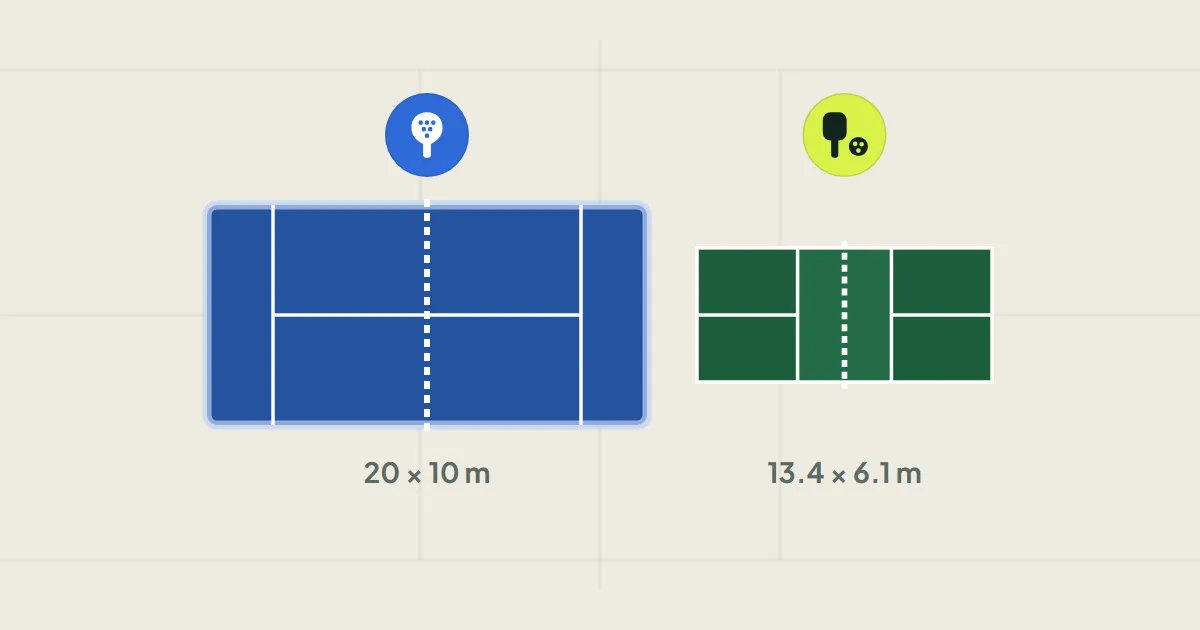
A padel court is a 20m × 10m rectangle, fully enclosed. The International Padel Federation (FIP) rules set the back walls at 3m of glass or solid wall with 1m of metal mesh on top, and the sides are part wall, part mesh. The court also needs at least 6m of clear height, and the FIP suggests 8m for new builds.
A pickleball court is 20 ft × 44 ft (6.10m × 13.41m), according to the 2026 USA Pickleball rulebook. That’s almost exactly a badminton doubles court, which is why so many courts here are badminton halls with extra lines. More on that in our post on pickleball court size.
So a padel court takes up more than twice the floor of a pickleball court. It also needs glass, a steel frame and a high roof, while a pickleball court can be painted onto a floor that already exists.
Why padel courts cost more to hire
Those walls are the main reason. A padel court has to be purpose-built with tempered glass, steel mesh and lighting mounted high above the court. A pickleball court can share a badminton hall, a tennis court or a car park roof. Malaysia4U’s 2026 guide puts it plainly: glass-walled padel courts carry a higher building cost, and venues recover it through the hourly rate. Malaysia’s heat adds to this. Covered or indoor padel courts are more comfortable but cost more to build, so they cost more to book.
Published estimates of what a court costs to build in Malaysia don’t agree with each other, so we haven’t quoted one here.
How the games are different
The walls in padel
In padel, the ball has to bounce on your opponents’ side first. After that, it can come off the back or side glass and stay in play, and you can hit it after it bounces off the wall. You can also play the ball against your own walls to get it back over. If your shot hits the opponents’ wall or the mesh before it bounces, you lose the point (FIP rules, Rule 13).
This is the part new players find strangest. The instinct from other racket sports is to hit the ball before it reaches the back wall, and learning to wait for it to come off the glass takes a few sessions.
The kitchen in pickleball
Pickleball has no walls. Its special rule is the non-volley zone, called the kitchen: the 7 ft (2.13m) strip on each side of the net. You can’t volley (hit the ball before it bounces) while standing in it. There’s also the two-bounce rule: the serve must bounce, and then the return of serve must bounce, before anyone can volley (rule 10.A). These two rules slow the game near the net and reward soft, placed shots. Our kitchen rule guide covers the edge cases.
Serving
Both serves are underhand. In padel, you bounce the ball behind the service line, then hit it at or below waist height, diagonally into your opponent’s service box. You get two tries, as in tennis (FIP Rule 6).
In pickleball, you serve from behind the baseline, diagonally, and the serve must clear the kitchen. A volley serve has to be hit with an upward arc and below the waist. A drop serve lets you drop the ball and hit it after it bounces. You get one try. Our rules guide walks through it.
Scoring
Padel uses tennis scoring: 15, 30, 40, game, then sets of six games. At 40–40, clubs use one of three options in the FIP rules. They’re traditional advantage, a single “golden point”, or the new “Star Point”, where a game that reaches deuce for the third time is settled by one deciding point. Ask which one your group plays before you start.
Pickleball games usually go to 11, win by 2, and in standard scoring only the serving side can score. Doubles players call three numbers before each serve, such as “4–2–1”, which confuses almost everyone at first.
Equipment
A padel racket is solid, with no strings. The face has holes drilled through it, and the FIP limits the total length to 45.5cm. It must have a wrist cord, and you have to wear it. The ball looks like a tennis ball but has slightly less pressure.
A pickleball paddle is also solid with no strings, and the length plus width can’t be more than 24 in (60.96cm). The ball is hollow plastic with holes. Outdoor balls have smaller holes and are harder; indoor balls have larger holes.
Malaysia4U lists entry-level padel rackets at about RM250–500. For pickleball, it gives RM150–400 for entry paddles and about RM80 for budget paddles on Shopee and Lazada. If you’re not sure yet, rent first. In Singapore, Ricochet rents padel rackets at S$10 an hour (MissLobang). In Malaysia, pickleball paddle rental was about RM4–5 a session in RinggitPlus’s August 2025 survey. For buying, see how to choose your first pickleball paddle.
What it costs to play
Prices were checked in October 2026. Courts are booked per court per hour, and four players usually split the bill.
Malaysia
| Off-peak | Peak | Source | |
|---|---|---|---|
| Padel, suburban Selangor | RM100–140 | RM140–180 | Malaysia4U, updated 3 May 2026 |
| Padel, central KL | RM130–180 | RM180–240 | Malaysia4U |
| Padel, premium or panoramic courts | RM160–220 | RM220–280 | Malaysia4U |
| Pickleball, suburban | RM20–40 | RM40–60 | Malaysia4U |
| Pickleball, mid-tier KL and PJ | RM40–60 | RM60–80 | Malaysia4U |
| Pickleball, premium | RM50–80 | RM80–120 | Malaysia4U |
Split four ways, padel works out to about RM25–70 each per hour, and pickleball about RM8–30 each. Pickleball also has open play: drop-in sessions where you rotate through games, usually RM25–40 a person for two to three hours. Malaysia4U notes that padel has fewer open sessions, and most clubs expect you to bring your own four.
For single venues: The Rally Padel Club on the Quill City Mall rooftop charges RM80 off-peak and RM120 peak for guests of The Chow Kit hotel, rackets included (The Chow Kit). Pickle Depot in Sentul, which has both sports, listed padel from RM140 and pickleball from RM60 when it opened (SAYS, July 2025). That’s older than our other figures, so check before you go.
Singapore
| Venue | Sport | Off-peak | Peak | Source |
|---|---|---|---|---|
| Love All Sports, West Coast (open-air) | Padel | S$45 | S$80 | MissLobang |
| The Sports Arina @ Jalan Kayu (sheltered) | Padel | S$50 | S$90 | MissLobang |
| Padel X, Expo (air-conditioned) | Padel | S$78 | S$108 | MissLobang |
| ActiveSG indoor court (citizen/PR) | Pickleball | S$3.50 | S$7.40 | ActiveSG |
| ActiveSG outdoor court (citizen/PR) | Pickleball | S$4.50 | S$9.50 | ActiveSG |
| The Sports Arina, Expo Hall 7 | Pickleball | S$25 (weekdays 7–11am, air-con off); S$30 (weekdays 11am–6pm, air-con on) | S$40 | MissLobang |
ActiveSG’s standard rate for non-residents is higher: S$4.60 / S$9.70 indoors and S$5.90 / S$12.50 outdoors. ActiveSG peak hours are 6–10pm on weekdays, and 7am–10pm on weekends and public holidays.
Singapore has more than 25 padel clubs with about 70 courts, according to MissLobang’s 2026 round-up. Pickleball has dozens of ActiveSG halls and outdoor courts on MyActiveSG+, plus private venues and free HDB courts. Our Singapore booking guide explains how to get an ActiveSG slot.
Which is easier to learn?
Both are easier to start than tennis, because the court is smaller and the serve is underhand. The difference comes after the first session.
Pickleball’s basic rally comes quickly, especially if you’ve played badminton, since the court and footwork feel familiar. The hard part comes later: the soft game at the kitchen line. Many players get stuck there for months.
Padel’s first hour can be more confusing because of the walls and the tennis scoring. Malaysia4U recommends three or four lessons before your first competitive game. Group clinics are listed at RM80–150 a person for 90 minutes, against RM50–100 for a pickleball clinic. In Singapore, Padel X runs an “Intro to Padel” session for S$58, according to MissLobang.
If you’ve played tennis or squash, padel’s movement and full swings may feel more natural. If you’ve played badminton, pickleball’s court and net play usually click faster. See from badminton to pickleball for what carries over.
How hard is each on the body?
Both are doubles games with short sprints, so neither is as demanding as singles tennis or badminton. Padel has more running and overhead shots, and longer rallies, because the walls keep the ball alive. Pickleball has more crouching and quick hands at the net.
Both can cause elbow and calf problems if you suddenly play a lot more, and we couldn’t find a local study comparing injury rates in the two. Warm up, build up slowly, and see a physiotherapist if pain lasts more than a couple of weeks.
So which should you try first?
Try pickleball first if cost and convenience matter most. It’s cheaper per person, there are far more courts outside the Klang Valley and central Singapore, open play means you don’t need to bring three friends, and your badminton shoes and instincts will mostly work.
Try padel first if you already have three friends keen to split a court, you like a running game with full swings, or you’ve played tennis or squash. Book an intro clinic rather than just a court, because the walls make more sense with a coach.
Or try both. One off-peak hour of each will tell you more than any comparison table.
Sources
- Rules of Padel, review applicable from 1 January 2026, International Padel Federation
- 2026 Official Rulebook, USA Pickleball
- Pickleball & Padel in Malaysia, Malaysia4U (updated 3 May 2026)
- Best padel courts in Singapore 2026, MissLobang
- Best pickleball courts in Singapore 2026, MissLobang
- Individual rates, ActiveSG (last updated 25 August 2026)
- The Rally Padel Club, The Chow Kit
- The largest pickle and padel courts just opened in Malaysia, SAYS (July 2025)
- How much does it really cost to join the pickleball craze?, RinggitPlus (August 2025)
- Indoor pickleball courts in the Klang Valley, for heat and rainRead
- Where to play pickleball in Cheras: 11 venues with pricesRead
- Where to play pickleball in Ipoh: 11 venues with pricesRead
- Where to play pickleball in Johor Bahru (including for Singaporeans)Read
- Where to play pickleball in Kuala Lumpur: 20 venues with pricesRead
- Where to play pickleball in Kuching: 7 venues, plus MiriRead