You’ve booked a court, or a friend has talked you into a session, and you want to know enough of the rules to play a proper game without holding everyone up. Here’s the short version. Serve underhand and diagonally. Let the serve bounce, and let the return bounce. Don’t volley while standing in the kitchen, the zone next to the net. Only the serving side scores, and the first side to 11 points with a 2-point lead wins.
The rest of this page explains each of those in plain terms. Most of us came from badminton, so it compares the two as it goes. Each topic has its own post if you want the detail.
Which rulebook this guide follows
This guide follows the 2026 USA Pickleball Official Rulebook, which came into force on 1 January 2026. Rule numbers in brackets, like (10.A), point to that book. The 2026 edition renumbered every rule, so older guides that quote “Rule 4.A” for the serve are using the old numbers.
There’s a second rulebook too. The UPA-A, the body behind the PPA Tour and Major League Pickleball, publishes its own. For a social game the two agree on almost everything in this post, and the posts on the serve and the kitchen point out the few places they differ.
The court is about the size of a badminton doubles court
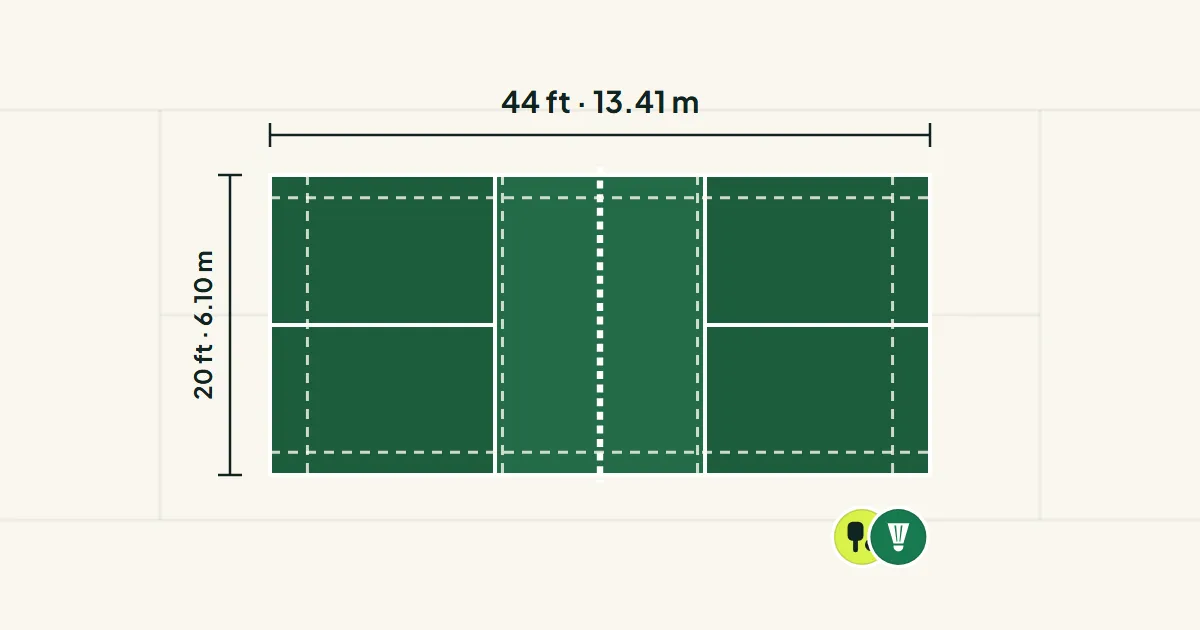
A pickleball court is 13.41 m long and 6.10 m wide (44 ft by 20 ft), the same for singles and doubles (3.A.1). That’s within a centimetre of a badminton doubles court, which is why pickleball lines can be marked straight onto a badminton court.
The big difference is the net. It’s 91.4 cm high at the sidelines and 86.4 cm in the middle (3.B.6, 3.B.7), roughly hip height and well over half a metre lower than a badminton net. Each half of the court has a 2.13 m deep kitchen next to the net, and behind it a left and a right service court. For exact measurements, line widths and how the lines sit on a badminton court, see pickleball court size.
The serve starts every rally
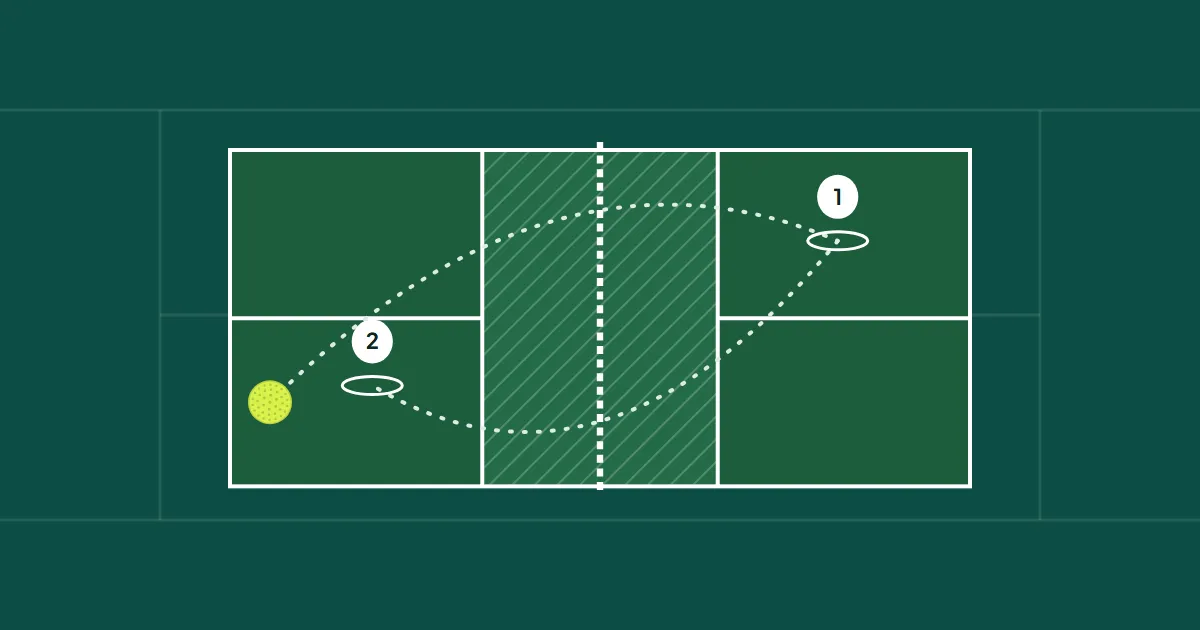
The serve is underhand. The server stands behind the baseline and hits the ball diagonally across the net, into the service court opposite. The serve must clear the kitchen, and a serve that lands on the kitchen line is out (7.E, 8.C).
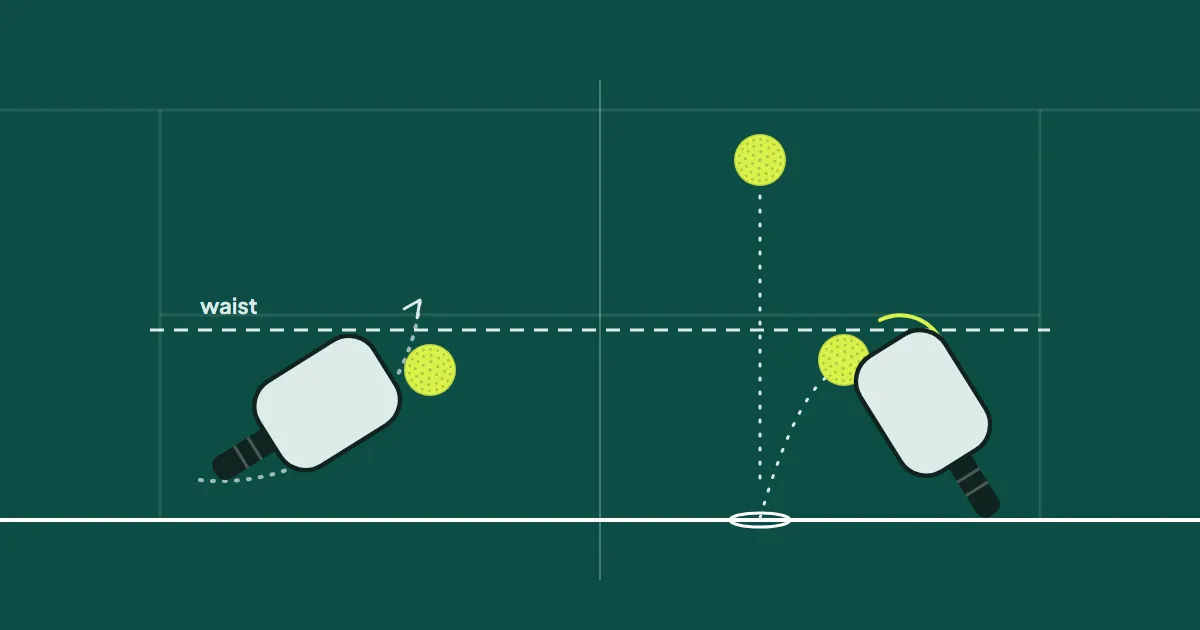
You get one serve, not two as in tennis. If the serve touches the net and still lands in the right court, it’s in play, with no let. There are two legal ways to serve: a volley serve, hit out of the air, and a drop serve, where you drop the ball and hit it after it bounces (7.C, 7.D). The serve rules post covers both, plus the mistakes that cost new players most of their points.
The two-bounce rule: both sides let the ball bounce once
After the serve, the receiving side must let the ball bounce before hitting it. Then the serving side must let the return bounce before hitting it (10.A). After those two bounces, anyone can volley, which means hitting the ball out of the air, or play it off the bounce.
It’s easy to forget if you come from badminton, where nothing ever bounces. It’s also why the serving side usually stays back at the baseline for the first two shots instead of rushing the net. A ball may never bounce twice on your side (10.B).
The kitchen: no volleys from the zone next to the net
The kitchen is the official “non-volley zone”: the 2.13 m strip on each side of the net (3.A.4.c). You can’t volley while you’re touching it, and that includes the line itself. You also can’t volley and then let your momentum carry you into it, even after the ball is dead (11.A.1, 11.A.2).
You’re allowed to stand in the kitchen at any time, and you can step in to hit a ball that has bounced. The rule only applies to volleys. That’s the part most beginners get wrong, in both directions. The kitchen rule post walks through the edge cases.
How you lose a rally
A rally ends when someone commits a fault. The common ones are:
- Out or into the net. Your shot lands outside the court, or doesn’t get over the net (10.C.1, 10.C.2).
- Two bounces. You let the ball bounce twice before hitting it (10.B.1).
- Breaking the two-bounce rule. You volley the serve, or your side volleys the return of serve (10.A.1, 10.A.2).
- Kitchen fault. You volley while touching the kitchen, or your momentum takes you into it (11.A).
- Ball hits you. The ball touches you or your clothes, anywhere but your paddle or your paddle hand below the wrist (10.C.3). This applies even if you’re standing well outside the court and the ball was going out. Let it go past rather than catching it.
- Touching the net. You, your paddle or your clothes touch the net or the posts while the ball is in play (13.G).
- Hitting a fixed object. Your shot hits the ceiling, a light or a fence before it lands (10.C.4). In converted badminton halls with low roofs, a high lob can be a fault before it comes down.
- Reaching over. You hit the ball before it has fully crossed to your side (13.F). You may follow through over the net after hitting it (13.I.1), but you can’t touch the net.
Line calls: a ball on the line is in, except the kitchen line on a serve
A ball that touches any line is in, with one exception: a serve that lands on the kitchen line is out (8.B, 8.C). Lines on a pickleball court belong to the area they mark, as they do in badminton.
In a social game without a referee, each side calls the lines on its own end of the court. You may only call a ball out if you can clearly see a gap between the ball and the line (8.E). If you’re not sure, it’s in, and the opponent gets the benefit of the doubt (8.D). If you and your partner disagree, the ball is in (8.H). Spectators must not be asked (8.J), which is worth remembering when friends are watching from the bench.
Scoring: only the serving side scores
In standard scoring, you only score a point when your side is serving and wins the rally (4.A). If the receiving side wins the rally, it doesn’t score. It wins the right to serve instead.
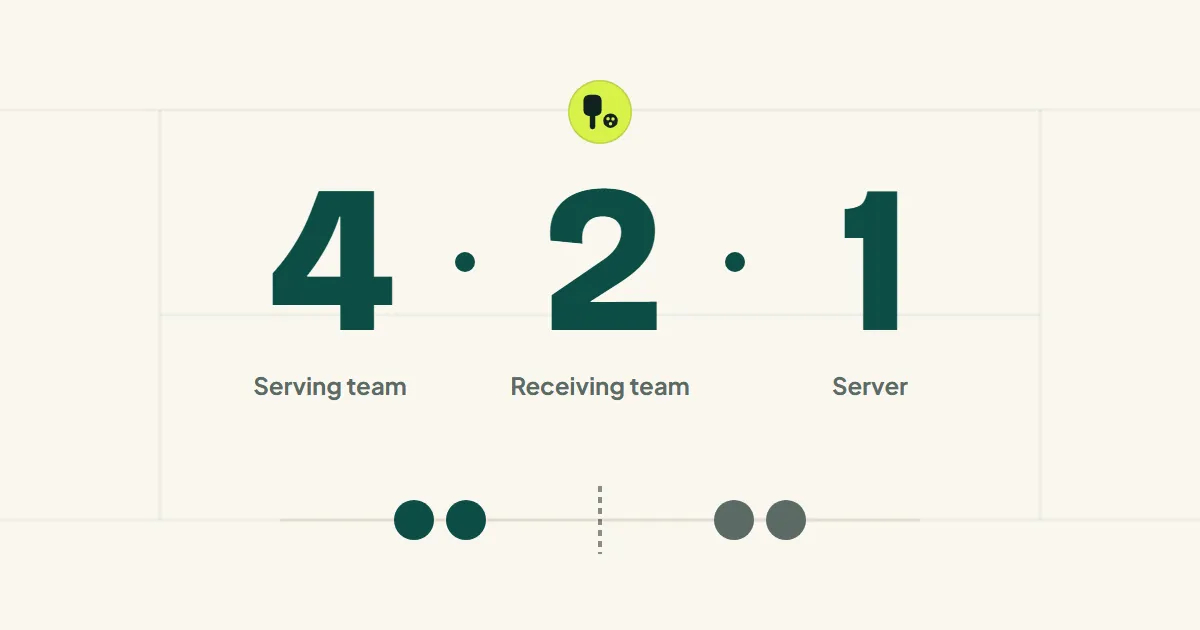
In doubles, both partners serve before the serve passes to the other side, except at the very start of the game, when only one player serves. That’s why the score has three numbers, like “4-2-1”: your score, their score, and whether you’re the first or second server. The first call of every game is “0-0-2” (6.B.2). The doubles scoring post walks through a full game, rally by rally.
Some events and clubs now use rally scoring instead, where every rally wins a point, as in badminton. USA Pickleball lists it as a provisional option for 2026 (14.A), and its 2026 change document says it will decide in 2027 whether to keep it.
How you win a game
A standard game goes to 11 points, and you must win by 2. At 10-10 you keep playing until one side leads by 2 (Section 1, 15.C). Tournaments also use games to 15 or 21, and matches can be one game or best of three.
Eleven points sounds short next to badminton’s 21, but with side-out scoring many rallies end with no point scored, so a game takes longer than the number suggests.
What’s different from badminton
| Pickleball | Badminton (doubles) | |
|---|---|---|
| Court | 13.41 m × 6.10 m | 13.40 m × 6.10 m |
| Net height at centre | 86.4 cm | 1.524 m |
| Serve | Underhand, diagonal, must clear the kitchen | Below 1.15 m, diagonal, must pass the short service line |
| Serves per turn | One | One |
| Ball bounces | Must bounce on serve and return | Never bounces |
| Zone near the net | Kitchen: no volleys while touching it | No restriction |
| Who scores | Serving side only (standard scoring) | Either side, every rally |
| Game length | 11 points, win by 2 | 21 points, win by 2, capped at 30 (games of 15 from 4 January 2027) |
Badminton figures are from the BWF Laws of Badminton. The BWF’s members voted in April 2026 to switch to games of 15 points from 4 January 2027.
What changed in the 2026 rulebook
If you learned from an older guide, these are the changes that matter in a social game:
- Spin on the serve. You still can’t spin the ball with your hand or paddle as you release it, but spin from the paddle at the moment of contact is legal (7.B.2). USA Pickleball’s 2026 change document calls this one of the most misunderstood rules.
- Volley serve. The upward swing, low paddle head and below-waist contact must each be “clearly” met (7.C).
- Out calls must be prompt. The old window of “any time before the next serve” is gone (8.F.3).
- Partners disagree, the ball is in. This replaces the old wording about “doubt” (8.H).
- Rally scoring. Under the provisional rally scoring option, the receiving side can now win the game on its own game point (14.A.2).
USA Pickleball plans to publish the 2027 rulebook on or about 15 December 2026, to take effect on 1 January 2027, according to the change document. Check back in January if you’re reading this later.
Your first game
You don’t need every rule on day one. Learn the serve, the two bounces, the kitchen and the score call, and you can play a full game. The rest you’ll pick up by playing. If a call confuses you, ask: in a game without a referee, players are expected to explain the score and positions when asked (5.C, 6.E.1).
Sources
- 2026 USA Pickleball Official Rulebook, USA Pickleball
- 2026 USA Pickleball Rulebook Change Document, USA Pickleball (published 17 December 2025, edited 30 January 2026)
- UPA-A Official Rulebook 2026–2027, United Pickleball Association of America
- Laws of Badminton (BWF Statutes, Section 4.1, in force 29 May 2023), Badminton World Federation
- Indoor pickleball courts in the Klang Valley, for heat and rainRead
- Where to play pickleball in Cheras: 11 venues with pricesRead
- Where to play pickleball in Ipoh: 11 venues with pricesRead
- Where to play pickleball in Johor Bahru (including for Singaporeans)Read
- Where to play pickleball in Kuala Lumpur: 20 venues with pricesRead
- Where to play pickleball in Kuching: 7 venues, plus MiriRead