If you’re losing points before the rally even starts, it’s almost always the serve. The rules fit in a few lines. Stand behind the baseline, wait until the whole score is called, hit the ball underhand, and send it diagonally over the net so it lands past the kitchen line in the service court opposite. You get one try.
This post goes through each part of the serve, where the 2026 rulebook changed things, and the faults new players make most. Rule numbers in brackets refer to the 2026 USA Pickleball Official Rulebook, Section 7 unless stated. For the game as a whole, start with our plain guide to pickleball rules.
A legal serve, as a checklist
- The full score has been called, and you serve within 10 seconds of the call ending (6.C, 6.D).
- At least one foot is on the ground behind the baseline, and neither foot touches the baseline, the court, or the ground outside the extensions of the sideline and centre line (7.A).
- You release the ball with one hand or from the paddle, where the receiver can see it, with no spin added on release (7.B).
- Your swing meets the volley serve rules or the drop serve rules below (7.C, 7.D).
- The ball goes diagonally over the net, clears the kitchen and its line, and lands in the correct service court (7.E).
Miss any of these and it’s a fault: the serve is lost.
Where to stand
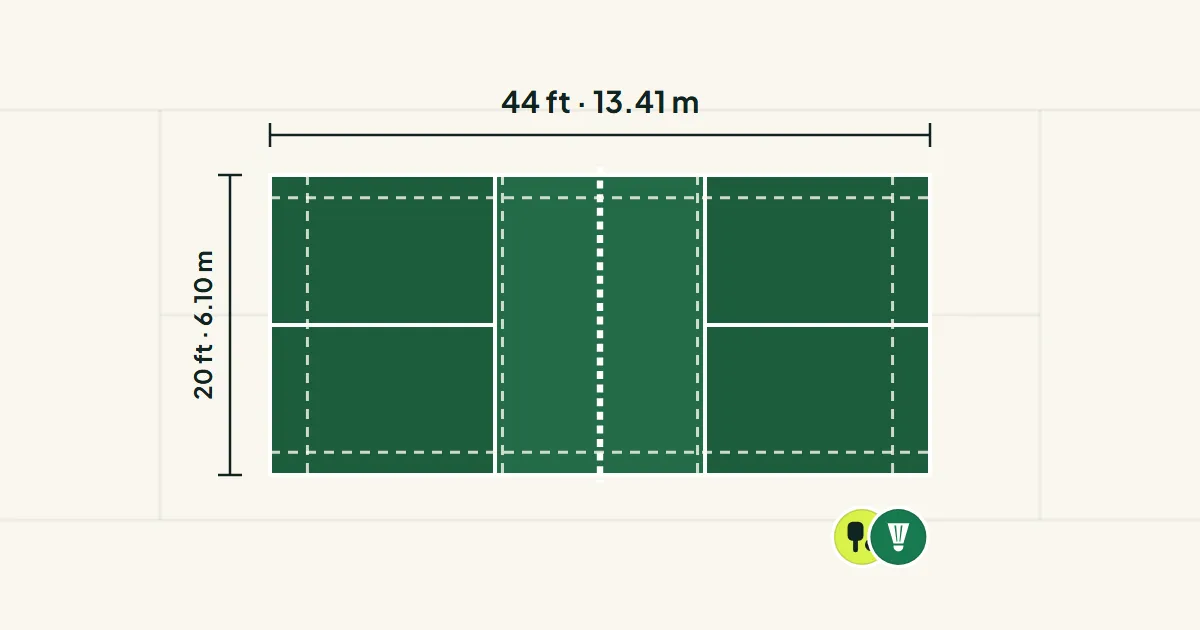
Stand behind the baseline, inside the area you’d get by extending the sideline and centre line backwards (3.A.4.g). You serve from the right side or the left depending on the score. In singles it’s the right when your score is even and the left when it’s odd (5.A.1). In doubles it depends on your team’s score and who started on the right, which our doubles scoring guide explains.
At the moment you hit the ball, one foot must be on the ground (7.A.1). Neither foot may touch the baseline or the court in front of it (7.A.2), and neither may be outside your serving area, sideways (7.A.3). Unlike badminton, you don’t have to keep your feet still: you can step forward as you swing, as long as your feet are behind the line when the paddle meets the ball.
Your partner can stand anywhere on your side, inside or outside the court. The rulebook only fixes the positions of the server and the receiver (5.B.4).
Wait for the score call
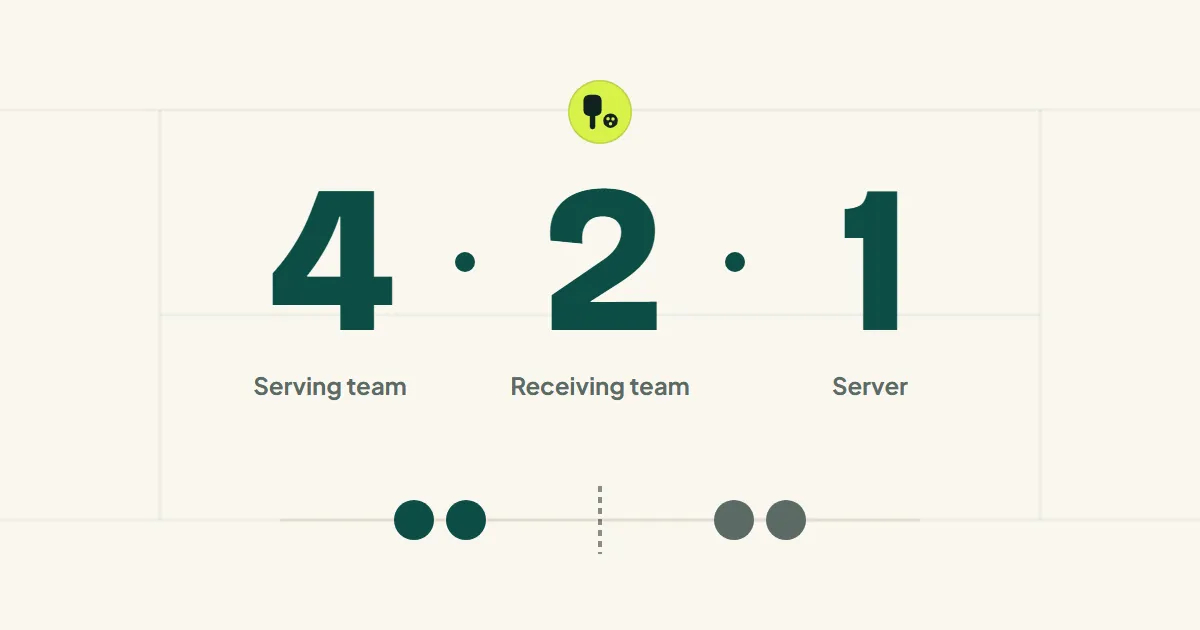
The score must be called in full before you serve (6.C). In doubles that’s three numbers, like “3-5-1”. If you hit the ball while the score is still being called, it’s a fault (6.C.1). Once the call ends, you have 10 seconds to serve (6.D).
If the receiver isn’t ready, they should signal it before the score call starts, by raising a paddle or a hand above the head, or turning their back to the net (6.A.1). After the call starts, a “stop” or “wait” is still recognised (6.E).
Releasing the ball
You can drop the ball from your hand or let it roll off your paddle (7.B.1). The receiver must be able to see the release. If they can’t, they can ask for the serve to be replayed before returning it (7.B.3, 7.B.3.a).
You can’t add spin as you release the ball, whether with your fingers or with the paddle (7.B.2). The serve where players twist the ball in their fingers before hitting it is illegal. If the receiver thinks you’ve added spin on the release, they can call for a replay, but only before they return the serve (7.B.2.a).
What changed in 2026: spin put on the ball by the paddle when it strikes the ball is legal, and the rule now says so outright (7.B.2). USA Pickleball’s 2026 change document calls this “one of the most misunderstood rules”. No spin from the release, but spin from the hit is fine.
The volley serve: hit it out of the air
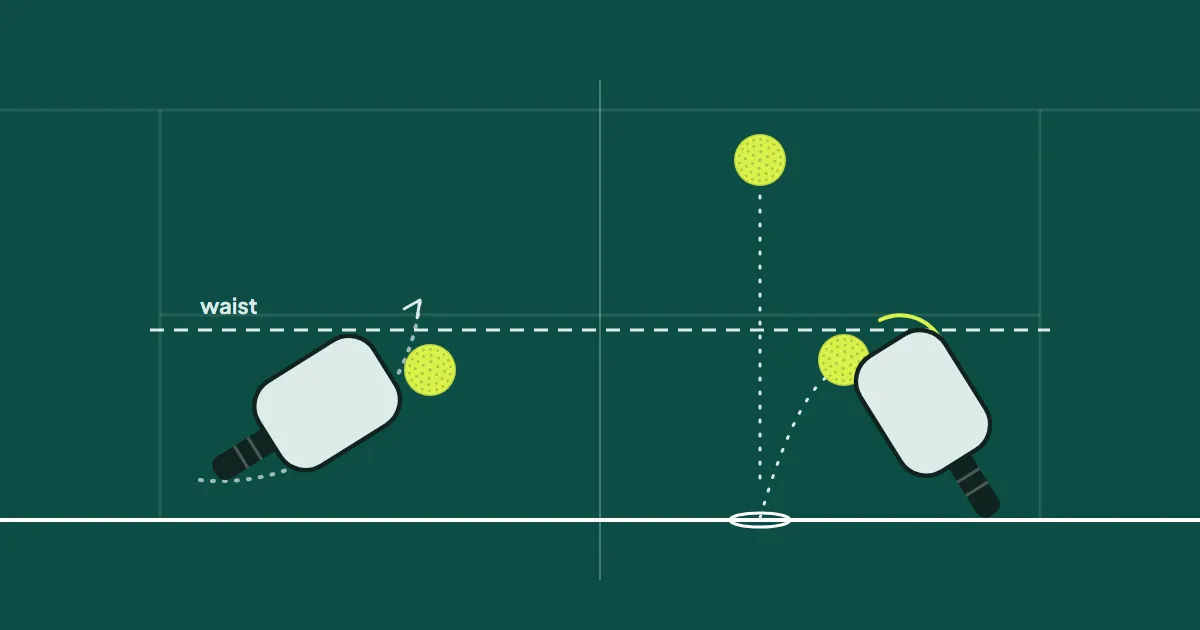
A volley serve is hit before the ball bounces. At the moment the paddle meets the ball, three things must all be clearly true (7.C):
- Upward swing. Your paddle is moving in a clear upward arc (7.C.1).
- Paddle head low. The top of the paddle head is clearly not above the highest part of your wrist (7.C.2).
- Ball low. The ball is clearly no higher than your waist (7.C.3).
Forehand or backhand are both fine (7.C.4). The word “clearly” was added to all three in 2026 to make them easier to enforce. A flat, sideways swing that only just meets the rules is now more likely to be called.
The drop serve: let it bounce first
A drop serve is hit after the ball bounces. You drop the ball from a natural height, and you can’t throw it down or toss it up (7.D.1, 7.D.2). After that, there’s no limit on how many times it bounces or where on the ground it bounces before you hit it (7.D.3, 7.D.4). Forehand or backhand are both fine.
The upward-swing, wrist and waist rules for the volley serve don’t apply to the drop serve. With fewer rules to get wrong, it’s a good serve to learn first.
Where the serve has to land
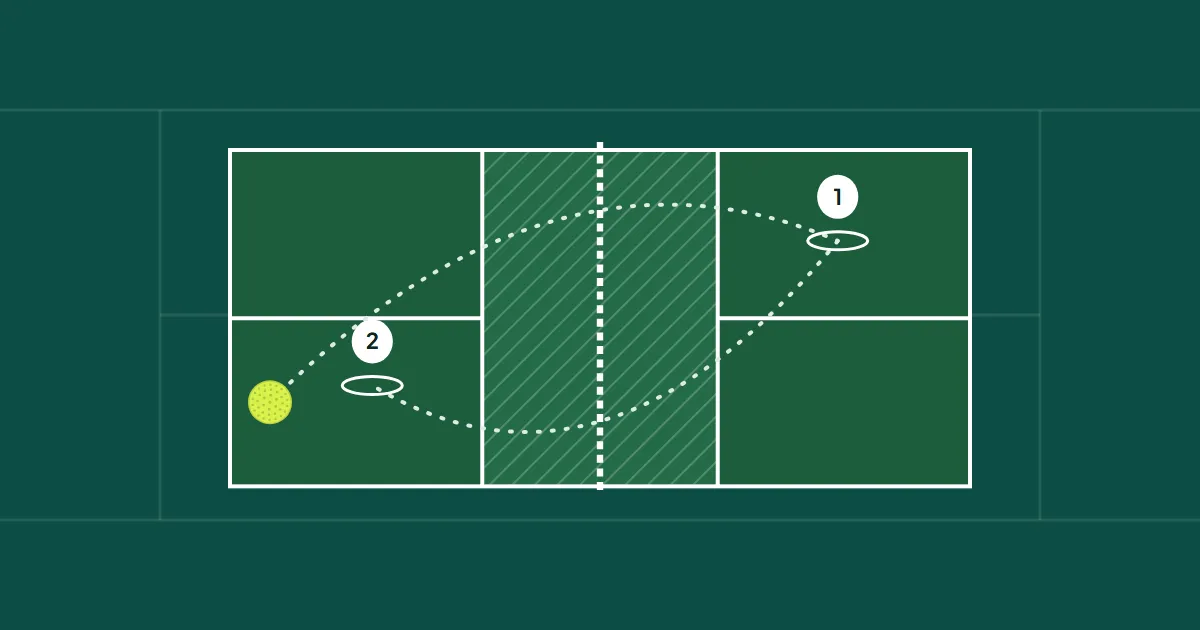
The serve must go to the service court diagonally opposite and clear the kitchen (7.E):
- Baseline, sideline and centre line count as in. They’re part of the service court (3.A.4.f).
- The kitchen line counts as out. A serve that lands on it is a fault (7.E.2, 8.C). This is the one line in pickleball where touching the line is bad for the hitter.
- Touching the net is fine. If the serve clips the net and still lands in the right court, play on. There are no lets.
- Hitting your partner is your fault. If the serve hits you or your partner, the serve is lost (7.E.4).
- Hitting the receiver is their fault. If the serve hits the receiver or their partner before it lands, the point goes to the serving side (7.E.5).
- Hitting the roof is your fault. A serve that touches a ceiling, light or other fixed object before landing is a fault (7.E.3).
After the serve lands, the receiver must let it bounce before hitting it, and your side must let the return bounce too. That’s the two-bounce rule (10.A).
How the UPA-A rules differ
The UPA-A rulebook, used at PPA Tour and Major League Pickleball events, agrees with USA Pickleball on where to stand and where the serve lands. Its serve rules differ in a few details (Rule 5.3):
- Drop serve bounces: only one bounce is allowed before you hit it, where USA Pickleball allows any number.
- Drop serve release: the ball may be dropped from any height, as long as it isn’t thrown or given extra force or spin.
- Volley serve swing: the swing must clearly go from low to high and must not look like a side-to-side motion.
If a tournament you enter names its rulebook, check which one applies. For a social game, a drop serve that you simply let fall from a natural height and hit after one bounce is legal under both.
Coming from badminton
The badminton serve trains some good habits and a few that cost you here:
| Pickleball | Badminton | |
|---|---|---|
| Where you stand | Behind the baseline | Inside your service court |
| Feet | One on the ground, can move | Both stationary on the ground |
| Height limit | Ball below the waist (volley serve) | Whole shuttle below 1.15 m |
| Where it must land | Past the kitchen line, in the diagonal court | Past the short service line, in the diagonal court |
| Front line | Out (kitchen line) | In (short service line) |
| Net touch | Play on | Play on |
Badminton figures are from the BWF Laws of Badminton, Law 9.
The front line is the one to watch. In badminton a serve on the short service line is good, and the line sits 1.98 m from the net. In pickleball the kitchen line is 2.13 m from the net and a serve on it is out. A short, flat serve that wins points in badminton is a fault here.
Serve mistakes beginners make
Most of us made some of these in our first few sessions:
- Stepping on the baseline. Your toe touches the line as you swing (7.A.2). Stand a little further back than feels necessary.
- Serving before the score is finished. It’s a fault, even in a friendly game (6.C.1).
- Serving from the wrong side. Check the score before you walk to the line. Even score in singles means the right side.
- Hitting too high on a volley serve. Contact above the waist, or a paddle head above the wrist, is a fault (7.C). If you can’t stop doing it, switch to the drop serve.
- Tossing the ball for a drop serve. Under USA Pickleball rules you must drop it, not throw it up or down (7.D.2).
- Spinning the ball with your fingers. Spin on release is illegal (7.B.2). Spin from the paddle is fine.
- Serving short into the kitchen. Aim deep. A serve that lands near the baseline also gives you more time.
- Rushing the net after serving. Your side must let the return bounce (10.A.2). Stay back until it does.
What to practise next
Pick one serve, hit 20 in a row to the same service court, and count how many land. A deep, steady serve that always goes in is worth more than a hard one that misses one time in four, because a missed serve gives the other side the ball for nothing.
Sources
- 2026 USA Pickleball Official Rulebook, Sections 5, 6, 7 and 10, USA Pickleball
- 2026 USA Pickleball Rulebook Change Document, entries 15 and 23, USA Pickleball
- UPA-A Official Rulebook 2026–2027, Rule 5, United Pickleball Association of America
- Laws of Badminton (BWF Statutes, Section 4.1, in force 29 May 2023), Law 9, Badminton World Federation
- Indoor pickleball courts in the Klang Valley, for heat and rainRead
- Where to play pickleball in Cheras: 11 venues with pricesRead
- Where to play pickleball in Ipoh: 11 venues with pricesRead
- Where to play pickleball in Johor Bahru (including for Singaporeans)Read
- Where to play pickleball in Kuala Lumpur: 20 venues with pricesRead
- Where to play pickleball in Kuching: 7 venues, plus MiriRead