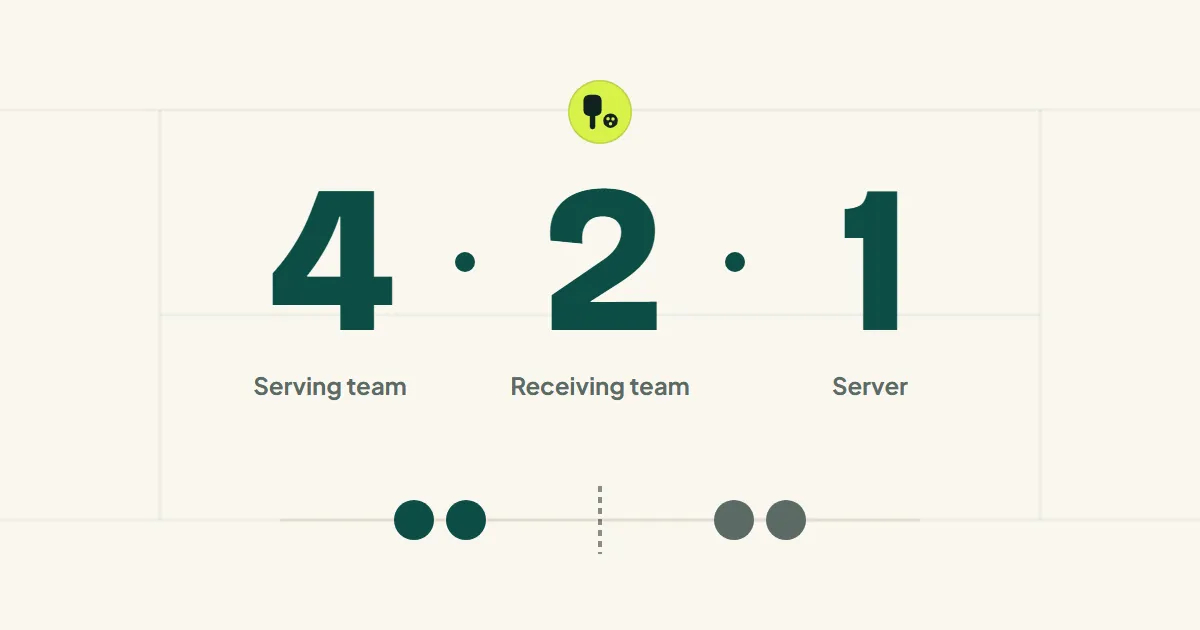
The score call in doubles, three numbers like “4-2-1”, trips up most of us at first. Here’s what it means. The first number is the serving team’s score, the second is the receiving team’s score, and the third says whether this is the team’s first or second server (6.B.2). Only the serving team can score. Each team gets two serves before the ball passes to the other side, except at the very start of the game, which is why every game opens with “0-0-2”.
Below, we go through the rules one at a time, then play out the first ten rallies of a game so you can follow every call. Rule numbers refer to the 2026 USA Pickleball Official Rulebook. For the rest of the game, see our plain guide to pickleball rules.
The rules in six lines
- Only the serving team scores. If the receiving team wins the rally, it scores nothing, and the serve moves on (4.A).
- Each team has two servers. When the first server loses a rally, their partner serves. When the second server loses a rally, it’s a side out: the serve passes to the other team (5.B.5, 5.B.6).
- Except at the start. The team that serves first in a game gets only one server before its first side out. That’s why the opening call is “0-0-2”: the team starts as if it’s already on its second server (5.B, 5.B.2).
- After a side out, the player on the right serves first (5.B.2).
- Only the server’s team moves. When the serving team wins a point, the server and partner swap sides, and the server serves again from the other side. The receiving team never swaps (5.B.5).
- First to 11, win by 2. At 10-10 the game goes on until one team leads by 2 (Section 1, 15.C).
How to call the score
The server calls the score before every serve, in this order: serving team’s score, receiving team’s score, server number (6.B.2). The whole call must be finished before the serve (6.C).
So “5-3-2” means: our team has 5, they have 3, and I’m our second server. If the call is wrong, any player can stop play before the return of serve to correct it, and the rally is replayed (6.F.1). Once the rally is over, the result stands and the score is fixed before the next serve (6.F.4). Stopping play to challenge a score that was actually correct is a fault against you (6.F.2).
The check that settles most arguments
Each team has a starting server: the player who stood on the right at the start of the game. The rule is simple (5.B.3):
- When your team’s score is even (0, 2, 4…), your starting server should be on the right.
- When your team’s score is odd, your starting server should be on the left.
This works whether you’re serving or receiving. If you’re lost, check your score and where your starting server is standing. If it doesn’t match, someone is out of position. Under the UPA-A rulebook used at PPA Tour and Major League Pickleball events, the starting server wears a band so everyone can see who it is (Rule 4.5.2). In a social game, just remember who started on the right.
A worked example: the first ten rallies
Team A is Aisyah and Ben. Team B is Chen and Devi. Team A serves first. At the start, Aisyah is on the right for Team A and Chen is on the right for Team B, so they’re each team’s starting server.
| Rally | Score called | Server, serving from | Rally won by | What happens next |
|---|---|---|---|---|
| 1 | 0-0-2 | Aisyah, right | A | A scores: 1-0. Aisyah and Ben swap sides. |
| 2 | 1-0-2 | Aisyah, left | B | Aisyah was the second server, so side out. B serves. |
| 3 | 0-1-1 | Chen, right | B | B scores: 1-1. Chen and Devi swap sides. |
| 4 | 1-1-1 | Chen, left | A | No point. Serve passes to Devi, B’s second server. |
| 5 | 1-1-2 | Devi, right | B | B scores: 2-1. Devi and Chen swap sides. |
| 6 | 2-1-2 | Devi, left | A | Side out. A serves. |
| 7 | 1-2-1 | Ben, right | A | A scores: 2-2. Ben and Aisyah swap sides. |
| 8 | 2-2-1 | Ben, left | B | No point. Serve passes to Aisyah. |
| 9 | 2-2-2 | Aisyah, right | B | Side out. B serves. |
| 10 | 2-2-1 | Chen, right | … |
A few things to notice:
- Rally 2: Team A lost one rally and lost the serve straight away. That’s the “only one server at the start” rule.
- Rally 5: Devi serves from the right because that’s where she was standing. The second server doesn’t move to a set side. They serve from wherever they are.
- Rally 7: After the side out, Ben serves first, not Aisyah. Team A’s score is 1 (odd), so Aisyah, the starting server, is on the left, and Ben is on the right. The player on the right serves first.
- Rally 10: Team B’s score is 2 (even), and Chen, its starting server, is on the right. The check works.
- The score called is always from the server’s point of view. After rally 6, Team A’s 1 point comes first because Team A is now serving.
How a game ends
A team wins by reaching 11 with at least a 2-point lead. Because only the serving team scores, you can only win the game while you’re serving.
Say the call is “10-8-1”. If the serving team wins the rally, it’s 11-8 and the game is over. If the receiving team wins, it scores nothing and the serve passes to the second server, “10-8-2”. At 10-10, nobody wins at 11-10. You play on until it’s 12-10, 13-11 and so on.
In tournaments, games can also go to 15 or 21, and in a single game to 11 the teams change ends when one team reaches 6 (15.C.1, 21.B.1).
Mistakes that throw the score off
- Forgetting the “2” at the start. Calling “0-0-1” gives the first team an extra server it isn’t entitled to.
- Calling your opponent’s score first. Your own team’s score always comes first when you serve.
- The receiving team swapping sides. Only the serving team swaps, and only after winning a point.
- The wrong first server after a side out. It’s whoever is on the right, not whoever served first last time.
- The wrong player returning the serve. If the correct receiver was in position and the wrong partner returns the serve, that’s a fault against the receiving team (5.C.1.c). If someone is standing in the wrong place, you can stop play before the rally goes on to point it out, and the rally is replayed (5.C.1.a). If nobody notices until the rally is over, the result stands (5.C.2).
You can ask your opponents for the score, or who should be serving and receiving, before any serve, and they must tell you (5.C, 6.E.1).
Rally scoring: the badminton-style alternative
USA Pickleball allows rally scoring as a provisional option in 2026 (14.A). It’s closer to what badminton players know:
- A point goes to whichever team wins the rally, serving or not (14.A.2).
- The score is called as two numbers, server’s score then receiver’s score (14.A.3).
- Each team has only one server per turn. Lose a rally, and it’s a side out (14.A.5).
- After a side out, the player on the right, according to the team’s score, serves (14.A.4).
What changed in 2026: under the 2025 rules, a team could only win its game point while serving, even in rally scoring. That’s gone. The receiving team can now win the rally and the game at the same time (2026 change document, entry 20). Tournaments may use rally scoring except in double-elimination doubles and USA Pickleball’s Golden Ticket and National Championship events (15.C.2). The change document adds that USA Pickleball will decide in 2027 whether to keep it.
If you’ve played badminton doubles, rally scoring will feel familiar. In badminton, you also serve from the right when your score is even, only the serving pair swaps sides after winning a point, and each side has one server per turn (BWF Laws, Law 11). The main difference is the target: 21 points in badminton (15 from 4 January 2027, after a BWF vote), against 11, 15 or 21 in pickleball.
Before your next game, agree with the other three players which scoring you’re using. Then call the score out loud on every serve, even when it feels unnecessary. It’s the easiest way to keep four people on the same number.
Sources
- 2026 USA Pickleball Official Rulebook, Sections 4, 5, 6, 14, 15 and 21, USA Pickleball
- 2026 USA Pickleball Rulebook Change Document, entry 20, USA Pickleball
- UPA-A Official Rulebook 2026–2027, Rule 4.5.2, United Pickleball Association of America
- Laws of Badminton (BWF Statutes, Section 4.1, in force 29 May 2023), Laws 7 and 11, Badminton World Federation
- Indoor pickleball courts in the Klang Valley, for heat and rainRead
- Where to play pickleball in Cheras: 11 venues with pricesRead
- Where to play pickleball in Ipoh: 11 venues with pricesRead
- Where to play pickleball in Johor Bahru (including for Singaporeans)Read
- Where to play pickleball in Kuala Lumpur: 20 venues with pricesRead
- Where to play pickleball in Kuching: 7 venues, plus MiriRead