You’ve played a few sessions with a borrowed or rented paddle, you want your own, and the shop shelf is a wall of numbers: 14mm, 16mm, T700, elongated, thermoformed. This guide explains what those words mean, which ones matter in your first year, and what each price band in ringgit gets you.
The short answer first. For most beginners, a midweight paddle (about 210 to 235 g), with a standard or hybrid shape, a 16mm core and a fibreglass or carbon face, does the job. In Malaysia, that costs anywhere from about RM100 to RM500. You don’t need to spend more until you know what you like, and the best way to find out is to try a few paddles before you buy.
We haven’t tested the paddles named here. They’re examples of what’s on sale in Malaysia at each price, not picks.
Try before you buy
Most venues here rent paddles at the counter. RinggitPlus put paddle rental at about RM4 to RM5 a session in 2025. That’s a small add-on to a court booking, and it’s the cheapest way to learn what you like. Friends at open play will usually let you hit a few balls with theirs, too.
When you try a paddle, hit the shots you actually play: a few dinks (soft shots that land in the kitchen, the non-volley zone next to the net), a few drives and a serve. Notice how heavy it feels after 20 minutes, whether the grip fits your hand, and whether off-centre hits still go where you meant. Pickleball Union’s demo guide suggests comparing feel, balance, grip size and sound across the same shots.
The five specs that matter, in plain words
Weight: start in the middle
Paddle weight is usually listed in ounces (oz). Light paddles are quick at the net but give less power and pass more shock to your arm. Heavy paddles hit harder and feel more stable, but they tire your arm and react slower.
Pickleball Union suggests beginners start midweight, about 7.3 to 8.3 oz (roughly 207 to 235 g), and try paddles around 7.5 to 7.8 oz (about 213 to 221 g) first. If your elbow or wrist is already sore from badminton or tennis, don’t go very light: a slightly heavier paddle absorbs more of the impact.
The rules don’t limit paddle weight at all. Under the 2026 USA Pickleball rulebook (Rule 3.D.3), any weight is legal.
Shape: standard or hybrid for most beginners
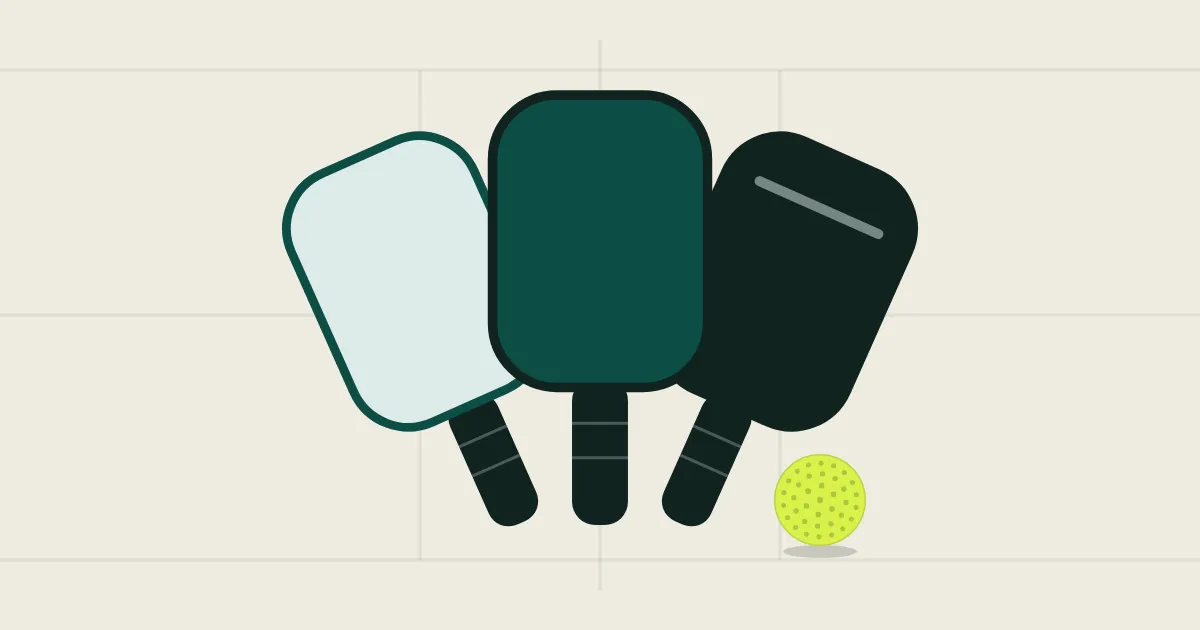
The rulebook caps a paddle’s length plus width at 24 inches (60.96 cm), and its length at 17 inches (43.18 cm) (Rule 3.D.2). Inside that limit, brands make three broad shapes:
| Shape | What it’s like | The catch |
|---|---|---|
| Standard (or widebody) | Shorter and wider. Biggest sweet spot, most forgiving. | Less reach, and a little less power on drives. |
| Hybrid | Between the two. Some extra length, most of the width. | “Hybrid” isn’t a fixed size, so two hybrids can feel quite different. |
| Elongated | Longer and narrower, usually about 16.5 inches (42 cm). More reach and power. | Smaller sweet spot. Off-centre hits feel dead, and it’s slower in quick exchanges at the net. |
Elongated paddles suit players who hit hard and play singles, according to Pickleball Union’s shape comparison. Most of us start in doubles, where the ball comes back fast and a forgiving face helps more than reach. That’s why a standard or hybrid shape is the safer first choice.
Many of us came from badminton, where reach is everything. A pickleball paddle is much shorter than a badminton racket whatever shape you choose, so don’t buy an elongated paddle just to feel closer to what you know.
Core thickness: 16mm is the forgiving one
Most paddles have a honeycomb or foam core, usually 13, 14 or 16mm thick. Thicker cores soak up pace; thinner cores give it back.
Pickleball Union’s comparison puts it this way: 16mm gives more control, a bigger sweet spot and less vibration, while 14mm gives more pop and is quicker to swing but is less forgiving. It recommends 16mm for beginners. A 13mm paddle sits further towards the power side.
In the first few months, most points are lost on balls that go too long or pop up, not on balls that lack power. A 16mm core helps with that.
Face material: fibreglass or carbon, both are fine at first
- Fibreglass faces are springier. They give easy power and are common on cheaper paddles.
- Carbon fibre faces are stiffer. They give more control and feel, and usually more spin. You’ll see “T700” or “raw carbon” on mid-range and premium paddles; T700 is a grade of carbon fibre.
Either is fine to learn with. If you’re choosing between two similar paddles, carbon tends to suit players who want control; fibreglass suits players who want easy power. Our post on why paddles cost RM80 or RM1,000 goes deeper into materials.
Grip size: measure your hand
Grip sizes are measured around the handle, and most people need between 4 and 5 inches (about 10 to 12.5 cm). Pickleball Union’s grip guide gives the most accurate test: lay your playing hand palm-up, and measure from the lower crease of your palm to the tip of your ring finger. That length is roughly your grip size. As a rough guide by height, people under about 157 cm often suit 4 inches, and people over about 173 cm often suit 4.5 inches.
If you’re between sizes, pick the smaller grip. You can build a grip up with an overgrip (a thin wrap that costs a few ringgit), but you can’t make a thick one thinner.
What each RM price band gets you
These are examples from Malaysian retailers’ own pages. Prices were checked in October 2026, and some were on sale at the time.
| Band | What you typically get | Examples on sale in Malaysia |
|---|---|---|
| Under RM150 | Fibreglass or basic composite face, honeycomb core. Fine for learning. Sets with two paddles and balls sit here too. | Decathlon Kuikma Play, RM59. Decathlon Play set (2 paddles, 2 balls, bag), RM129. Decathlon Kuikma Open (fibreglass, USA Pickleball approved), RM99 in the 10.10 sale, usually RM129. |
| RM150 to RM400 | Carbon faces from mainstream sports brands. A good “first real paddle” range. | Carlton WaveFlex (T700 carbon, 16mm) at Sports Direct, RM169. Decathlon Kuikma React (carbon faces, for regular players), RM149 in the 10.10 sale, usually RM199. Diadem Capsule 64 at Sports Direct, RM269. |
| RM400 to RM700 | Paddles from pickleball-only brands, often thermoformed with raw carbon faces. | Vatic Pro Prism V7 16mm at Picklefox, RM480. Wilson Fierce Max (13mm, fibreglass) at Wilson Malaysia, RM499. |
| RM800 and up | Current designs from premium brands, including foam cores. Mostly for players who already know what they like. | Six Zero Coral Pro 16mm at Picklefox, RM911. RPM Jade 16mm at Picklefox, RM1,104 (sold out when checked). |
Sources: Decathlon Malaysia, Sports Direct Malaysia, Wilson Malaysia, Picklefox.
Two Malaysian guides draw similar lines. Malaysia4u’s 2026 guide puts entry paddles at RM150 to RM400 and premium paddles at RM600 to RM1,200, and says carbon-face paddles from about RM80 on Shopee and Lazada are fine for testing the sport. RinggitPlus put “just starting out” at RM200 to RM500 in 2025.
Our view: a beginner who plays once or twice a week will be well served by something between RM100 and RM500. Spending more buys feel and features you’ll appreciate later, not points you’ll win now.
Three things to check before you pay
Is it on an approved list? Casual games don’t care. But if you might enter a tournament, check the paddle on the USA Pickleball approved paddle list. Approved paddles carry the “USA Pickleball Approved” mark (Rule 3.D.1). Paddles can also be removed from the list later, so check the model, not just the brand.
Is the seller real? Fakes of popular paddles are common online. Buy from the brand, an authorised shop, or the brand’s official store on Shopee or Lazada. Our guide on where to buy a pickleball paddle in Malaysia covers how to spot a fake.
What does the warranty cover, and for how long? It varies a lot by brand, from about 60 days to a year, and usually covers factory defects only. Ask before you buy, and keep the receipt.
When to think about upgrading
Once you’ve played for a few months, you’ll start to notice what you want more of: more reach, more spin, more control at the net. That’s the time to try a different shape or a pricier paddle, because now you’ll feel the difference. Paddles also wear out, especially if you play several times a week or leave yours in a hot car.
Your next step: rent or borrow two or three different paddles over your next few sessions, then buy the one you stopped thinking about while you played.
Sources
- 2026 USA Pickleball Official Rulebook, USA Pickleball (Rules 3.D.1 to 3.D.3)
- USA Pickleball equipment and approved paddle list, USA Pickleball
- The Ideal Pickleball Paddle Weight for Every Skill Level, Pickleball Union (updated September 2026)
- 14mm vs 16mm Pickleball Paddles, Pickleball Union (updated September 2026)
- Elongated vs. Hybrid Pickleball Paddles, Pickleball Union (updated September 2026)
- How to Measure the Grip Size for Your Pickleball Paddle, Pickleball Union
- Where & How to Demo Pickleball Paddles, Pickleball Union
- Pickleball paddle search, Decathlon Malaysia (checked 10 October 2026)
- Pickleball, Sports Direct Malaysia (checked 10 October 2026)
- Wilson Fierce Max Pickleball Paddle, Wilson Malaysia (checked 10 October 2026)
- Vatic Pro collection and paddles, Picklefox (checked 10 October 2026)
- Pickleball and padel guide, Malaysia4u (updated May 2026)
- How Much Does It Really Cost To Join The Pickleball Craze?, RinggitPlus (August 2025)
- Indoor pickleball courts in the Klang Valley, for heat and rainRead
- Where to play pickleball in Cheras: 11 venues with pricesRead
- Where to play pickleball in Ipoh: 11 venues with pricesRead
- Where to play pickleball in Johor Bahru (including for Singaporeans)Read
- Where to play pickleball in Kuala Lumpur: 20 venues with pricesRead
- Where to play pickleball in Kuching: 7 venues, plus MiriRead