You’ve booked a court for an hour with one friend, and you want to get better rather than just play games. Here are eight drills that fit into that hour, built from routines published by coaches and coaching sites. Each has a setup, a goal, and a way to make it easier or harder. There’s a 60-minute plan at the end that runs them in order.
Most of these drills happen close to the net, because that’s where most doubles points are won or lost, and it’s the part of the game that’s new to most of us coming from badminton or tennis. They also match how USA Pickleball’s skill level descriptions rate beginners at 2.5 and 3.0: how steady your dinks are, whether you can hit a drop shot to get to the net, and how much depth you get on serves and returns.
Before you start
- Bring four or five balls, so you’re not walking to the fence after every miss.
- Warm up for a few minutes first. Easy side-steps along the kitchen line and a few gentle rallies are enough.
- Count, don’t hit harder. In almost every drill here, the goal is a long rally, not a winner. Counting how many shots you make in a row keeps you honest.
- Swap roles often. Where one player feeds and one practises, switch every three to five minutes.
A word you’ll see a lot: the kitchen is the non-volley zone, the 7-foot (2.13 m) strip on each side of the net where you can’t volley. A dink is a soft shot that lands in the other side’s kitchen. If either is new to you, our rules guide and kitchen rule explainer cover them.
The 8 drills at a glance
| # | Drill | Where you stand | Skill |
|---|---|---|---|
| 1 | Straight-ahead dinks | Both at the kitchen line | Soft touch |
| 2 | Crosscourt dinks | Both at the kitchen line, diagonal | Soft touch, footwork |
| 3 | Soft volley rally | Both a step behind the kitchen line | Hands, paddle control |
| 4 | Deep serve and return | Both at the baseline | Serve, return |
| 5 | Third-shot drop feed | One at baseline, one at kitchen | The drop |
| 6 | Midcourt resets | One mid-court, one at kitchen | Absorbing pace |
| 7 | Crosscourt dinking game | Both at the kitchen line, diagonal | Dinking under pressure |
| 8 | Skinny singles | Half the court each | Putting it together |
1. Straight-ahead dinks
Setup: Both players stand just behind the kitchen line, facing each other on the same half of the court. Dink straight back and forth.
Goal: Every ball lands in your partner’s kitchen. No speed-ups or attacks. Selkirk’s two-player practice routine starts here, with the cue to volley a ball that would otherwise bounce at your feet.
Easier: Let every ball bounce, and aim for 10 in a row.
Harder: Aim for 30 in a row, or have your partner call a target (left foot, right foot, middle) before each shot.
2. Crosscourt dinks
Setup: Both players move to the same diagonal: both on the right-hand side (forehand for right-handers), dinking crosscourt. After five minutes, move to the left-hand side.
Goal: Long, steady crosscourt rallies. The crosscourt dink travels over the middle of the net, which is lower (34 inches or 86 cm, against 36 inches or 91 cm at the sidelines), and the diagonal gives you more room. Selkirk’s routine does five minutes on each diagonal.
Easier: Stand a little closer to the middle so the angle is gentler.
Harder: Move your partner around with your dinks: wide, at their body, then at their backhand side.
3. Soft volley rally
Setup: Both players stand a step behind the kitchen line and hit the ball back and forth without letting it bounce, as in the volley battle described by Pickleheads.
Goal: Keep the ball in the air at a gentle, steady pace. This trains short, compact paddle movements, with the paddle up in front of your chest. Badminton players tend to swing too big here, and that’s what this drill fixes.
Easier: Let a bounce happen whenever you need one.
Harder: Alternate forehand and backhand volleys, or speed up gradually while keeping control. Keep it friendly: this isn’t a contest to hit through each other.
4. Deep serve and return
Setup: Put a towel or water bottle about a metre inside the baseline in each service box. One player serves, the other returns deep, and you stop the rally there. Swap after ten serves.
Goal: Serves and returns that land deep. A deep return gives you time to move up to the kitchen. A short one invites the other side to attack. Target serving is one of the solo drills in the Pickleheads guide; a partner simply adds the return.
Easier: Forget the target and just get the serve in the correct box.
Harder: Make the target smaller, or call the target (wide, middle) before each serve.
5. Third-shot drop feed
Setup: One player stands at the kitchen line and feeds balls deep. The other stands at the baseline and tries to hit a soft, arcing shot that lands in the kitchen. This is the “third shot drop”, the shot after the serve and return that lets the serving team move forward. Both Selkirk and Pickleheads describe this setup.
Goal: Land the drop in the kitchen, or low enough at the net that your partner can’t attack it. It’s the hardest shot in this list, so expect misses. Think of it as a gentle lift, not a hit.
Easier: Start halfway back (mid-court) and move back a step every few successful drops.
Harder: After each drop, take two steps forward and play out the rally from there.
6. Midcourt resets
Setup: One player stands mid-court, about halfway between the kitchen and the baseline. The other stands at the kitchen line and hits firm, but not hard, balls at them: at their feet, in front of them, at chest height. Selkirk’s routine runs this straight-ahead, then on each diagonal, switching roles every three to five minutes.
Goal: Take the pace off and “reset” every ball softly into the kitchen. This is what you’ll do in games when someone hits hard at you before you’ve reached the net. Pickleball.com’s drill list uses the same idea for resets from the transition zone.
Easier: The kitchen player hits slower, and only to the forehand side.
Harder: After three good resets, the mid-court player moves up to the kitchen line and you play out the point.
7. Crosscourt dinking game
Setup: Both players on one diagonal at the kitchen line. Play crosscourt dinks to 5 points. No speed-ups. In the version on Pickleball.com, hitting the ball into the net loses all your points.
Goal: The same soft dinks as drill 2, but now with a score, so there’s some pressure. It teaches patience: whoever waits longest for a mistake usually wins.
Easier: A net ball costs one point instead of all of them.
Harder: Play to 11, or allow a speed-up only on a ball that bounces up high.
8. Skinny singles
Setup: Play singles using only half the court. In the version from Play Pickleball, you serve crosscourt, play to 11, and use the right half on even scores and the left half on odd scores.
Goal: Put the hour together: serve, return, a drop or drive, getting to the kitchen, then dinking. It’s the closest thing to a doubles game you can play with two people.
Easier: Agree that the serve and return must both bounce, then dink from there, and skip the scoring.
Harder: Add the rule that the third shot must be a drop, so you practise drill 5 under game pressure.
A 60-minute plan
| Time | Drill | Minutes | Note |
|---|---|---|---|
| 0:00 | 1. Straight-ahead dinks | 5 | Warm-up pace |
| 0:05 | 2. Crosscourt dinks | 10 | Five minutes on each diagonal |
| 0:15 | 3. Soft volley rally | 5 | Water break after |
| 0:20 | 4. Deep serve and return | 8 | Ten serves each, then swap |
| 0:28 | 5. Third-shot drop feed | 10 | Swap every five minutes |
| 0:38 | 6. Midcourt resets | 8 | Swap every four minutes; water break after |
| 0:46 | 7. Crosscourt dinking game | 6 | Best of three games to 5 |
| 0:52 | 8. Skinny singles | 8 | One game to 11 |
On an outdoor court, take a water break every 15 minutes or so, even if it costs you a few minutes of drilling. Book an early morning or evening slot if you can, or a covered court. If the hour feels like a lot, drop drill 4 and give its time to drills 5 and 6, where most beginners have the most to gain.
How often to drill
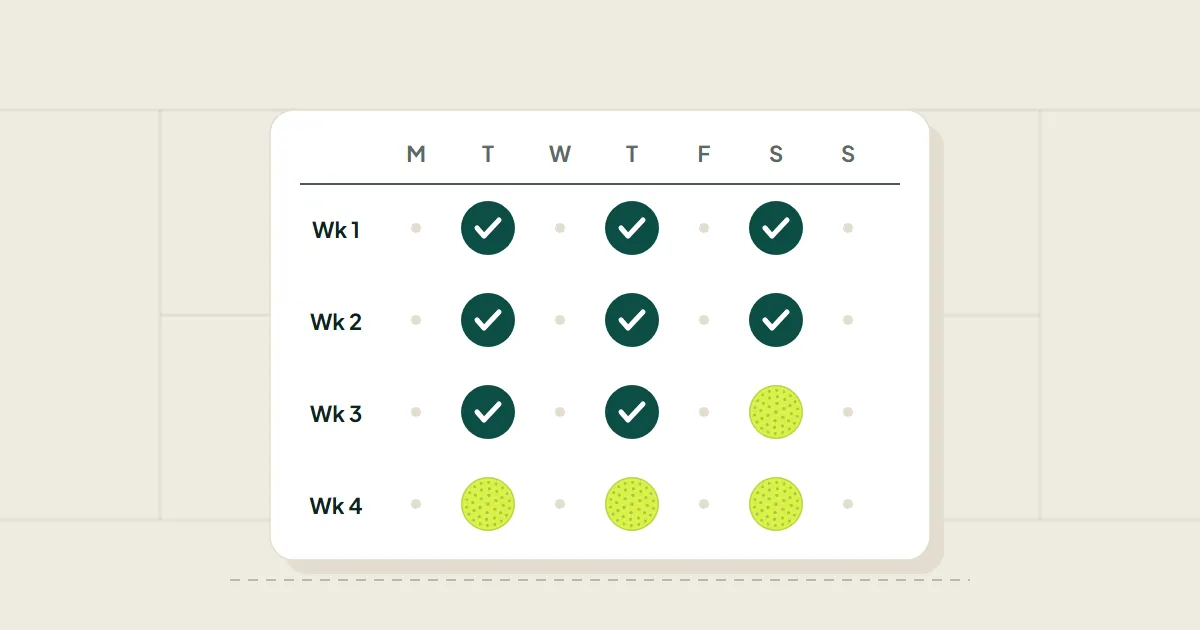
If you also play games, one drill hour a week is a sensible start. Then take one drill into your next game on purpose: “today I’m only going to dink crosscourt”. Court time costs money, so if you’re splitting a court, our guide to what pickleball costs in Malaysia shows where the cheaper off-peak hours are.
Pick drills 1, 2 and 5 for your next session if you only remember three.
Sources
- Skill levels, USA Pickleball
- An easy practice drill routine to level up your pickleball game, Selkirk (Stephen Bass, December 2022)
- Pickleball drills, Pickleheads
- Six pickleball drills that every player needs in their life, Pickleball.com
- Pickleball drills for 2 people, Play Pickleball (February 2024)
- Indoor pickleball courts in the Klang Valley, for heat and rainRead
- Where to play pickleball in Cheras: 11 venues with pricesRead
- Where to play pickleball in Ipoh: 11 venues with pricesRead
- Where to play pickleball in Johor Bahru (including for Singaporeans)Read
- Where to play pickleball in Kuala Lumpur: 20 venues with pricesRead
- Where to play pickleball in Kuching: 7 venues, plus MiriRead