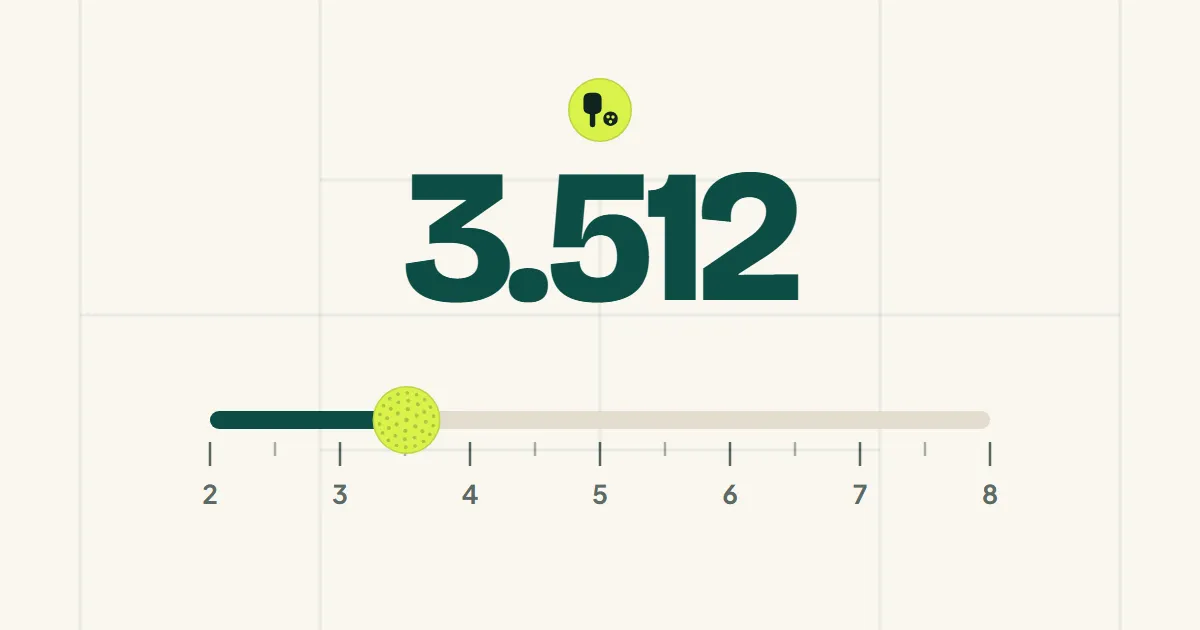
Sooner or later someone at the court asks, “What’s your DUPR?”, or a tournament you want to enter says “Men’s doubles, DUPR 2.799 and below”. DUPR is the rating most clubs and tournaments here use to sort players by level. It’s a number from 2.000 to 8.000, worked out from the results of your matches, and you get one by playing matches that are recorded on DUPR.
This post explains how the number moves, what the reliability score next to it means, how to get your first rating in Malaysia, and what the rules say about people who game it.
What is DUPR?
DUPR stands for Dynamic Universal Pickleball Rating. According to DUPR’s own explanation, every new player starts as “NR” (not rated), and ratings run from 2.000 to 8.000. You get separate ratings for singles, gender doubles and mixed doubles, plus an age-group rating if you’re 50 or over, and your rating updates automatically after each recorded match.
It isn’t a ranking. A ranking lists who is top of a competition. A rating estimates your level, so two players who’ve never met can be compared.
DUPR doesn’t publish fixed descriptions for each number. As a rough local guide, many beginner and novice events in Malaysia are capped somewhere below 3.0, and “intermediate” divisions are usually capped around 3.5. The tournament examples further down show this.
How is a DUPR rating calculated?
DUPR doesn’t publish its formula, but it explains the principles on its how-it-works page and in its FAQ. In plain terms:
- Before each match, DUPR predicts the result from everyone’s ratings. In doubles, each team’s rating is the average of the two players.
- After the match, it compares the actual score with the prediction. Beat the prediction and your rating goes up. Fall short and it goes down.
- The score margin matters, not only the win. DUPR’s FAQ gives the example that a heavy favourite may need to win by something like 11-3 to gain. So you can win and still drop, or lose a close game against a much stronger team and go up.
- Recent matches count more than old ones.
- Who reported the match matters. Matches submitted by a club, league or tournament carry more weight than scores you post yourself, as DUPR explains in its integrity FAQ.
- Your partner’s change can differ from yours, because each player’s adjustment also depends on how many matches they have and how recent they are.
What is the reliability score?
Next to your rating, DUPR shows a reliability score from 1% to 100%. It tells you how much to trust the number. A new player with three matches might have a rating of 3.2 and a low reliability score. Someone with 50 recent matches against lots of different opponents will have a high one.
The score goes up when you play more matches, against a wider mix of players. If you stop playing, DUPR’s FAQ says your rating stays where it is, but its reliability drops as your matches get older.
There’s no official pass mark, but Reclub’s help page says 60% is treated as the passing mark in the community, and that many clubs and organisers ask for at least 60% before you can join official DUPR leagues and tournaments. Check each event’s rules, because this varies.
Can you rate yourself?
Not in the way most people mean. You can’t type in your own DUPR number. DUPR says you stay NR until your first verified match, and that your rating comes from how you actually play, “not from a form you filled out once” (DUPR, July 2026). Online quizzes that “estimate your DUPR” give you a guess, not a rating.
What DUPR offers instead, according to its how-it-works page, is:
- Recorded matches, either self-reported in the app or submitted by a club or tournament organiser. Self-reported matches count for less.
- A coach assessment, where a certified DUPR coach watches you play and gives you a starting rating.
- An AI video rating, where you upload footage of your games to a partner service such as PB Vision.
How to get a DUPR rating in Malaysia
- Create a DUPR account in the DUPR app. You’ll start as NR.
- Play in DUPR-enabled sessions. Some club sessions on Reclub are DUPR-enabled, which the listing will say. Reclub’s help page says the host submits the scores after the session, and your first rating appears once your first valid match is in the system. Link your DUPR ID in your Reclub profile first.
- Expect big swings at first. Reclub notes that it’s normal for an early rating to jump up or down after the first few games.
- Keep going to 10 to 20 matches. That’s DUPR’s own advice for a rating you can trust, ideally against players near your level.
If you’re brand new, don’t rush this. Play a few weeks of social games first. A rating built while you’re still learning the rules will mostly measure that.
How Malaysian tournaments use DUPR bands
Most local tournaments split divisions by DUPR cap, so players compete against people of a similar level. Here are two examples from tournament listings on SportsSync:
| Tournament | Divisions and DUPR caps | Notable rules |
|---|---|---|
| Picklelab Open 2025, Pickle Lab, Penang (30 Oct to 2 Nov 2025) | Novice: max 3.0. Intermediate: max 3.5. Advanced: max 4.0. Open: any rating | Unrated (NR) players may enter Novice and Intermediate. Entries over the cap are voided with no refund. Only your primary DUPR account may be used |
| 2026 Malaysia Day Pickleball Tournament, Picklestop, Balakong (19 to 20 Sep 2026) | Men’s and mixed doubles below 2.799 and below 3.299. Women’s doubles below 2.599 and below 3.099. RM180 per team for the lower divisions, RM200 for the higher | Organiser checks your rating and record for the three months before the event. Intentional manipulation or duplicate accounts mean disqualification without refund |
Prices were checked in October 2026, from the listings linked above. Both events have already taken place.
Notice the caps ending in .099, .599 or .799. The Malaysia Day listing, for example, describes its “below 2.799” division as 2.0 to 2.799, so a 2.799 player is in and a 2.800 player is out. Check your rating to all three decimal places, and read how each event words its cap. Your rating can also change between registering and the event, and organisers handle that differently.
Clubs use the same bands for social sessions, such as “DUPR 3.0 to 3.5 round robin”. Our guide to pickleball tournaments in Malaysia covers how to find and enter one.
Malaysia’s DUPR community, by DUPR’s numbers
In an April 2025 post about the Alliance Bank KL Open, DUPR said Malaysia was third in the world for total DUPR users and the second fastest-growing country, that Kuala Lumpur was its fastest-growing city, and that there were more than 400 DUPR clubs in the country. These are DUPR’s own figures, published to promote the event, and we haven’t seen independent numbers. They’re also from April 2025, so they may have changed. The same post said the KL Open drew 648 players from 13 countries.
Common complaints, and what’s behind them
DUPR is useful, and it’s also argued about a lot. The complaints tend to fall into a few groups.
“My rating went down after I won.” This is usually the system working as designed: if you were expected to win 11-3 and won 11-9, you underperformed the prediction. It still feels unfair, and it’s one of the most common complaints in DUPR’s App Store reviews.
“Ratings jump around.” Early ratings move a lot because there’s little data. Matches against opponents with low reliability also give less certain results. DUPR’s FAQ says low-reliability opponents have a smaller effect on a reliable player’s rating.
“People game it.” On the Malaysian forum Lowyat, players have described DUPR as easy to manipulate, including strong players losing on purpose to bring their rating down so they can win lower-division events (Lowyat thread). App Store reviewers have reported duplicate profiles used to enter lower divisions. This is sandbagging, and it’s the complaint organisers take most seriously.
“Casual players get left out.” If an event needs a 60% reliability score, someone who plays socially every week but rarely in recorded matches may not qualify, even if their level fits.
The rules on sandbagging
Sandbagging means deliberately keeping your rating low to play in a weaker division. Several sets of rules apply.
- DUPR’s rules. DUPR’s community guidelines FAQ says players “may not manipulate ratings, results, or data in any manner”, and that those who do are restricted or suspended. Violations can be reported to DUPR support.
- DUPR Verified events. From 2026, DUPR is moving major tours and leagues to “DUPR Verified” events, where every player needs a DUPR+ subscription and a verified phone number, events are reviewed by a DUPR committee, and results carry more weight.
- Organisers’ own rules. Local events add their own, as the table above shows: primary accounts only, ratings checked over recent months, and the right to refuse or disqualify anyone who looks far better than their rating, sometimes without a refund.
If you think someone in your division is sandbagging, raise it with the tournament director rather than the player, and let them decide.
What to do with your rating
Treat your DUPR as a rough guide to which sessions and divisions suit you, not a score of your worth as a player. Play recorded matches against a mix of people, and the number will settle on its own. If you want it to go up, practise. Our beginner drills are a good place to start.
Sources
- How it works, DUPR (checked October 2026)
- What is a DUPR rating?, DUPR (July 2026)
- DUPR FAQs: your top questions answered by Sarah and Dave, DUPR (March 2024)
- DUPR integration, integrity, and info: your questions answered, DUPR (May 2024)
- The biggest pickleball tours and leagues go DUPR Verified in 2026, DUPR (September 2025)
- DUPR powers Malaysia’s Alliance Bank KL Open Pickleball Championship 2025, DUPR (April 2025)
- What is DUPR’s reliability score?, Reclub Help
- How do I get a DUPR rating?, Reclub Help
- Picklelab Open 2025, SportsSync
- 2026 Malaysia Day Pickleball Tournament, SportsSync
- Pickleball: any players here?, Lowyat.net forum
- DUPR ratings and reviews, App Store
- Indoor pickleball courts in the Klang Valley, for heat and rainRead
- Where to play pickleball in Cheras: 11 venues with pricesRead
- Where to play pickleball in Ipoh: 11 venues with pricesRead
- Where to play pickleball in Johor Bahru (including for Singaporeans)Read
- Where to play pickleball in Kuala Lumpur: 20 venues with pricesRead
- Where to play pickleball in Kuching: 7 venues, plus MiriRead